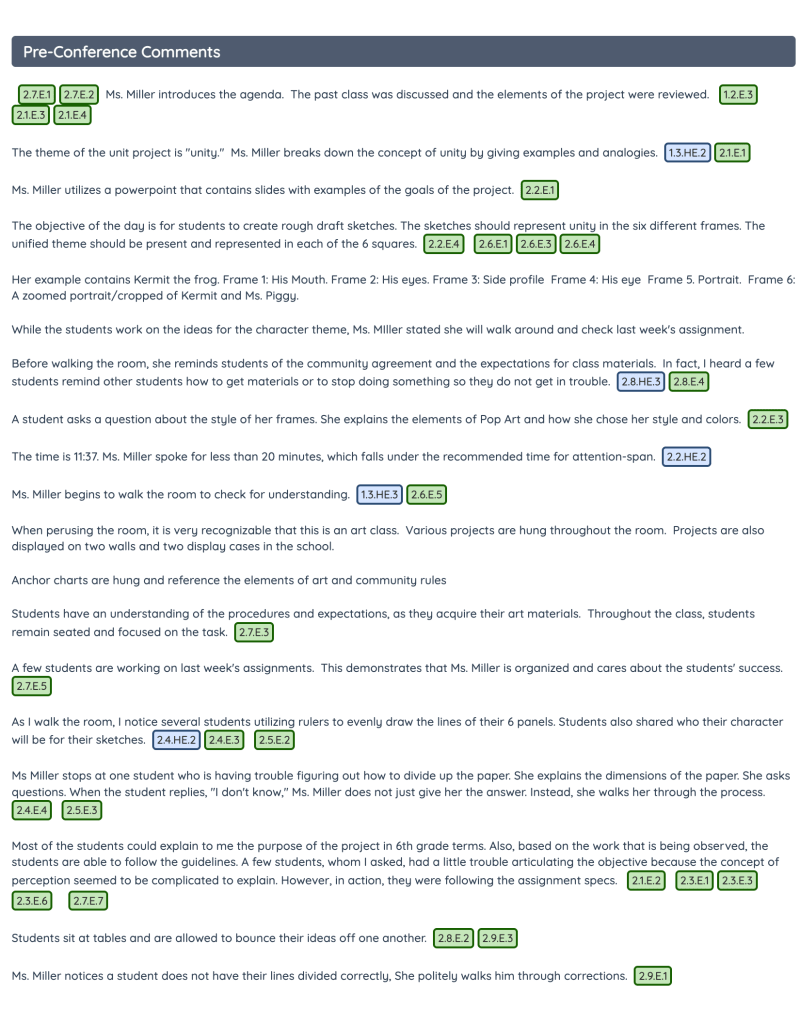
• I have provided my actual observation as I’ve just had one done; it is normal for us to receive a long observation before this upcoming long holiday break. The system used for observations is “Rise, Standard for Success.”

    Summary of My Observation:

    In the feedback from my observation, it was noted that I began the lesson by clearly reviewing the materials and concepts we had gone over in the days prior. I went on to launch our project and introduce the day’s objective within our unit theme of unity. I used analogies, examples, and slides with visuals to support my students’ understanding of the concept. The observer was one of our Instructional Coaches, and she highlighted that my expectations, procedures, and community agreements were consistently reinforced and well-established. Students were able to gather materials, settle into routines, and redirect one another without much intervention. My example using Kermit the Frog successfully demonstrated how to create six unified sketches from different perspectives, giving students a concrete reference for the assignment.

    The feedback also emphasized the positive classroom culture and my approach to checking for understanding. I am big on moving around my classroom and being involved with my students. So, it was also noticed that as I circulated, I asked guiding questions rather than giving answers outright, helping students think through challenges. Some of these things included dividing their papers into the six even panels needed to create this work of unity and variety. I do my best to encourage problem-solving where it is safe to do so. The observer noted that students remained focused, used rulers and materials correctly, and were able to explain the project’s purpose, even when the abstract idea of unity proved harder to articulate. Several students were finishing last week’s assignments, which was recognized as a sign of my ongoing care for their success and highlights my organization in managing multiple pacing needs.

    Finally, the observer highlighted the calm, supportive tone of the room and my interactions with students. I provided clarifications—such as explaining Pop Art choices—and offered gentle corrections when lines or divisions were off. Students were able to share ideas, collaborate, and engage with the artistic process in a way that reflected strong routines and a sense of community. Overall, the feedback affirmed that the classroom environment was structured, creative, and student-centered, and that my instructional choices supported both independence and artistic growth.

    Following my observation, I met with my instructional coach to discuss in person the domains that could be improved upon. We started by discussing the practices that are working well for me, and her praise was particularly high in the areas of routines and classroom culture. I would say that is the area that has become the strongest for me and my teaching.

    Area to Improve

    The area she felt I could improve on, and I agree, is my agenda. I should take a moment to explain why this is particularly important in the district I work in. We are a part of the New Tech Network, and the online “classroom” we use is Echo. Our district thoroughly enforces the use of agendas in Echo, and it is “law”. So much so that our “short observations” are on our agenda alone. The way that my agendas could be improved would be in the following ways- posting additional links to resources for students to utilize, breaking the activities down into minutes where possible to facilitate smooth transitions, consistently attaching standards to the activities listed on the agenda.

    I was granted understanding of these things because my class runs a little differently than most, including my other Encore class team. I teach grades 5-8, which is just the same as computer science, college and careers, P.E, and music. The difference with me, however, is that I teach four COMPLETELY different classes to each grade level. For example, the Encore team typically teaches a topic and uses a DOK (depth of knowledge) scale to cover that content slightly differently across grade levels because their level of understanding will vary; I, however, do not. Because of this, I have to make four different agendas every day. That, along with the fact that I also do not have a Chromebook cart in my classroom, means that students don’t utilize Echo much at all, and the focus on Echo is not as strong.

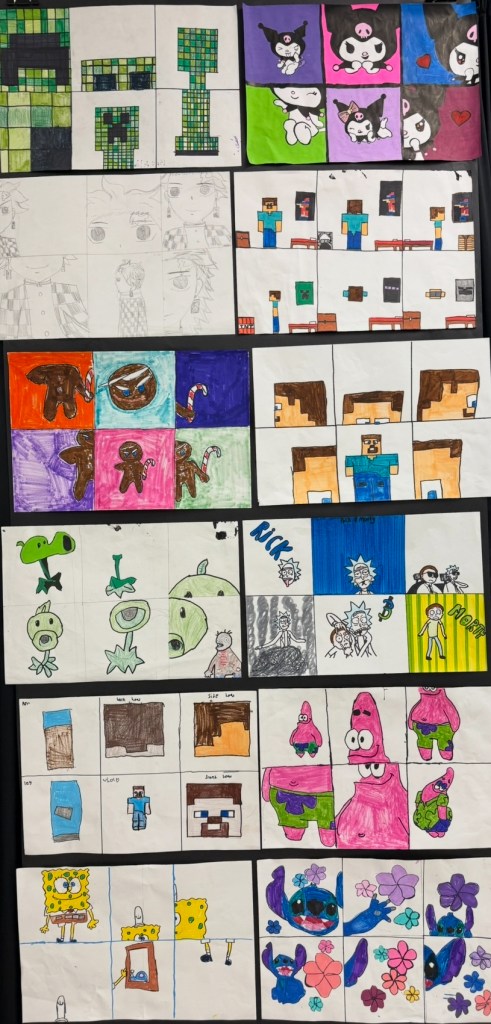
    *I included some finished examples of the project she is referring to in the observation.

  • Implementation:

    In an effort to introduce students to the idea of play and artmaking, I wanted to start with an activity that would loosen them up, but also do something that would be familar to them which is why music was incorporated.

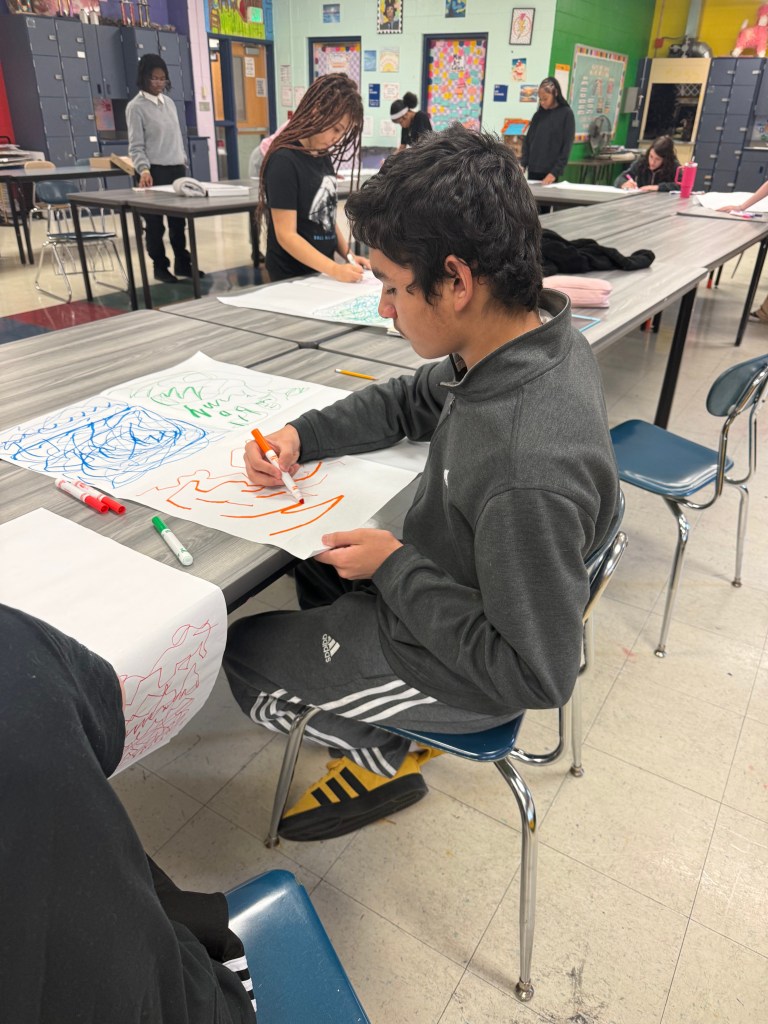
    Students were told that their focus should be on themselves and the music; no talking was allowed during this activity. Once they were ready at the work station they chose, they were instructed to make marks in response to different types of music I would play(fast, slow, calm, chaotic). The songs I used for these music types were “William Tell Overture” for fast, “Moonlight Sonata” for slow, jazz music from our SEL playlist in class for calm, and “Galop Infernal” for chaotic.

    At the start, I encouraged students to use their whole bodies. I demonstrated what that could look like from arm swings, trunk twists, and different shoulder motions. I showed the activity on the giant Post-It sticky notes as that is what the students would have been using.

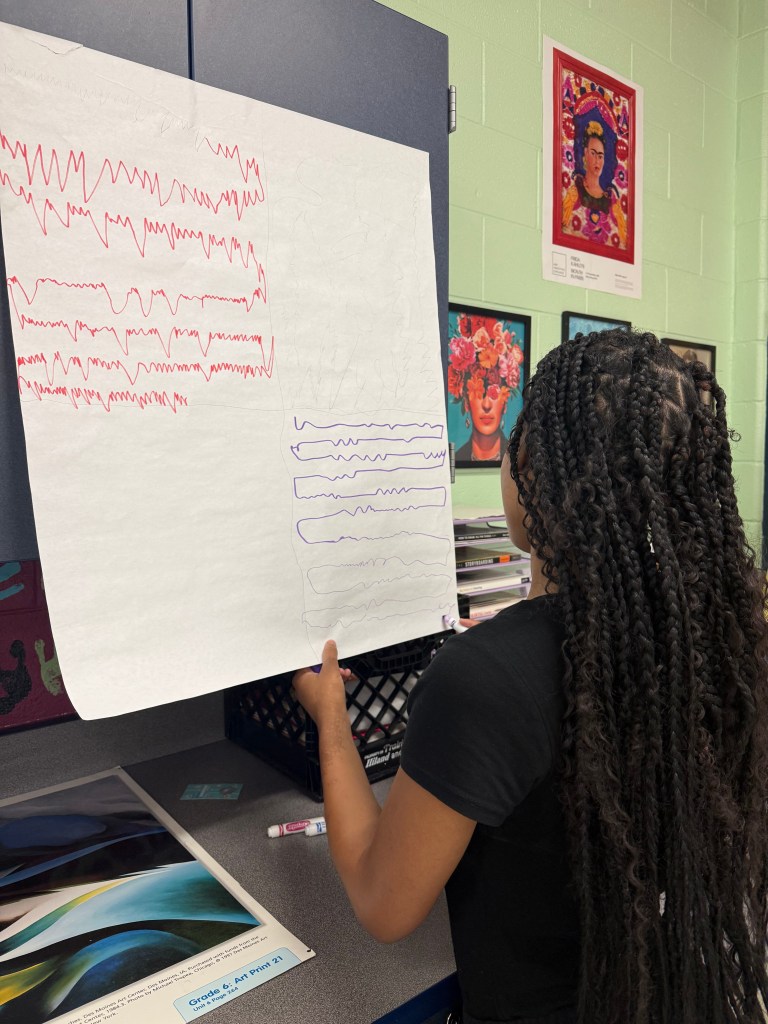
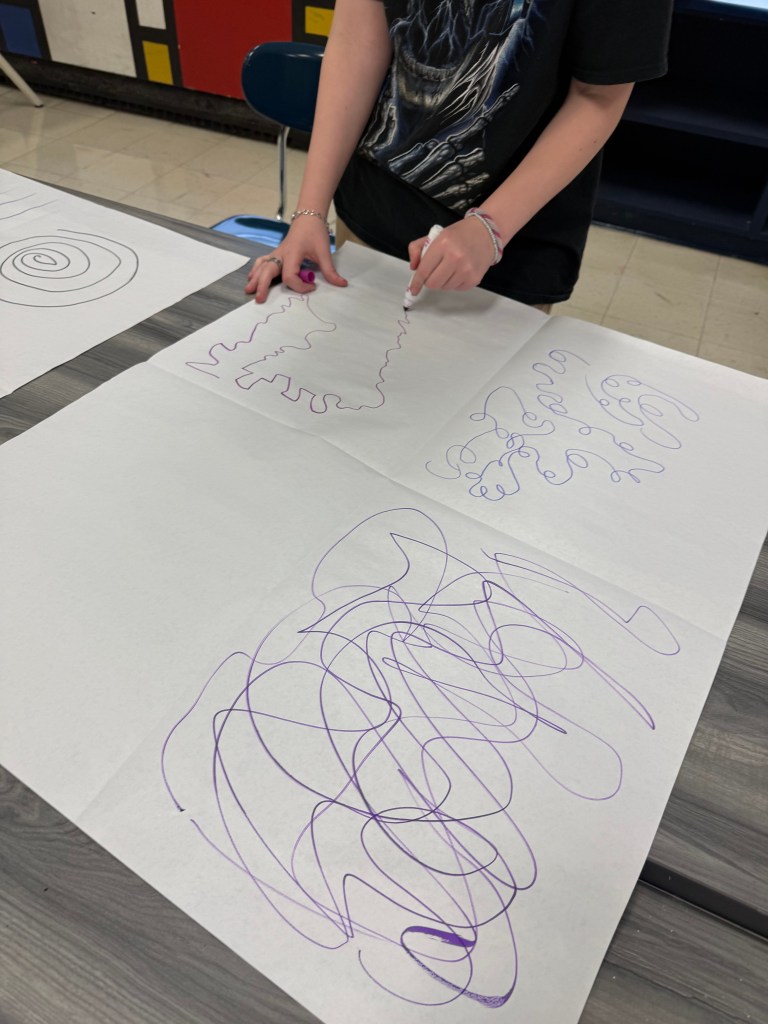
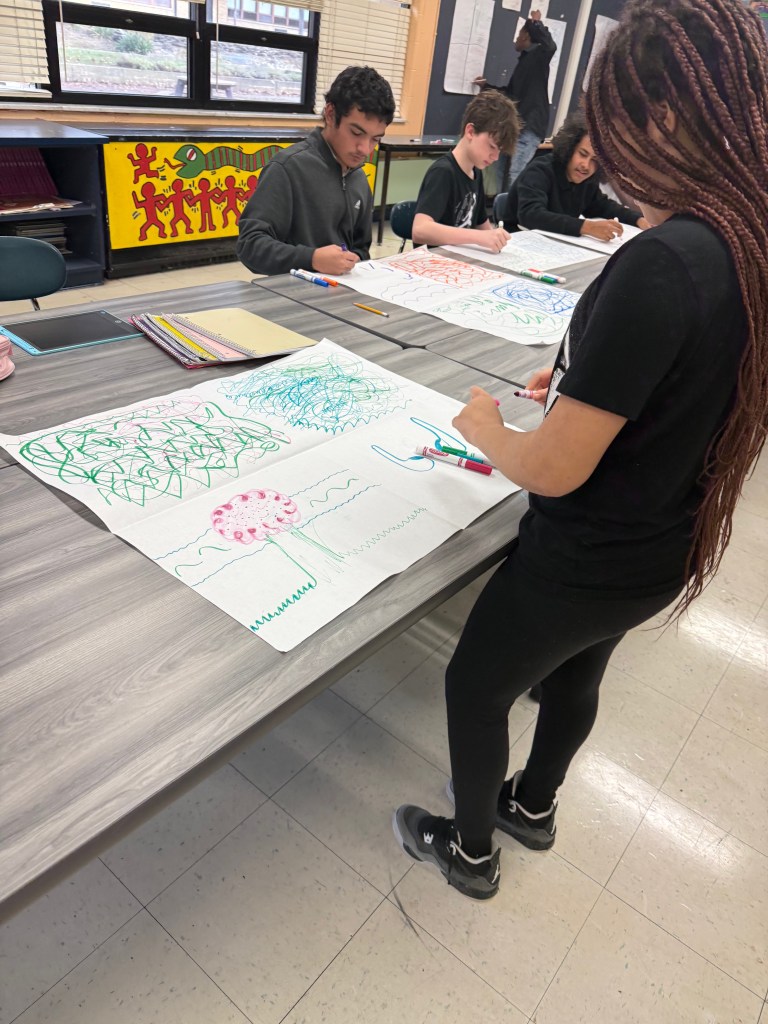
    Students were given their own giant Post-It and the ability to choose the colors they wanted to use. They were given the descriptors for each type of music and told to select colors that might represent their emotions for those particular types of songs. They were to draw division lines on their paper into four sections before the music began playing. I played each song and gave a brief pause between songs for students to observe and take in how movement changed their marks.

    As I played each song, students listened quietly and began making marks on their papers. I was happy to see so many students with their eyes closed, really taking in what they were hearing, and also a lot of movement and/ or dancing to the sounds they heard. I made sure to give a minute between each song so they could re-center before the next one.

    Reflection:

    After the activity, the students did a gallery walk to view their classmates’ work. I didn’t assign them a prompt at that moment and decided to just hang back and listen to the conversation as they freely walked the room, looking at all the colorful artwork. They noticed for themselves that most used zig-zag lines for both fast and chaotic. They also noticed that several of them had drawn heart shapes or shapes similar to hearts where “calm” music was played.

    After the gallery walk was concluded, they were given their exit survey for the activity. The exit ticket questions the students were given were as follows:

    1. How did the music affect the way you moved and the kinds of marks you made on your Post-it?
      What changed when the tempo or mood shifted?
    2. What emotion or feeling showed up for you the most during this activity, and where can you see it in your marks? (Think color, line quality, speed, pressure, etc.)
    3. What did you notice about yourself when you had to create without talking—did it change your focus, your comfort level, or your creativity?

    As for myself, I thoroughly enjoyed watching them do this activity. There was some laughter, a lot of dancing, and students who usually struggle to stay on task or even awake were engaged in the activity because it was my 1st period. I was also extremely pleased to hear some color and line explanation descriptions because they were using terminology from when I taught them in 5th grade; they’re 8th graders now.

  • The Big Idea Part 1: Project Plan

    Big Idea

    Big Idea: Physical Play: Movement, Gesture, and Embodied Artmaking
    Key Ideas for Artmaking: Experimentation, Process, and Meaning-Making through the Body

    I chose to focus on physical play as my big idea, inspired by Sydney Walker’s discussion in Artmaking, Play, and Meaning Making (2023), because it was the area that pushed me out of my comfort zone in a good way. Walker argues that engaging the body in artmaking invites new forms of awareness and creativity—encouraging artists to “see” differently through movement and tactile interaction rather than observation alone. I think that this will be really great for my students and will challenge them to view art as an experience instead of always focusing on what the end product looks like.

    Project Plan

    In this project, 6th and 8th graders will explore the artmaking and play list, and examples as Walker presents them. I will also go through examples with them and answer any questions they may have. I will consider these classes specifically for what kind of warm-up exercise will be suitable for the groups of students I have. So for this aspect, I just may have 4 different warm-ups. Students will then translate those movements into more intentional compositions that reflect emotion, rhythm, or narrative etc.

    This approach fits naturally into my curriculum’s emphasis on process over product, but it also challenges traditional classroom expectations—where students often equate “good art” with careful control or realism. Continuing to allow them to move, stretch, and even make “mistakes” while learning something new is going to work really well for us. This lesson reframes artmaking as an act of play and embodied thinking. For middle school students developing spatial and self-awareness, physical play is both developmentally appropriate and essential for fostering confidence and experimentation. I say all the time how these kids still need recess, so I am hoping to achieve that kind of feel with them.

    Lesson Plan Here: https://www.canva.com/design/DAG3mmO_ghM/fx2Gnvj966p17a3EmHBKDQ/edit?utm_content=DAG3mmO_ghM&utm_campaign=designshare&utm_medium=link2&utm_source=sharebutton

  • My classroom is the biggest in the building. I am not sure how many square feet it is, but it is pretty large. Every time someone comes into my classroom for the first time, they are completely overwhelmed by how large and bright it is. Along with how large the space itself is, I am lucky to have so much storage. I share no issues with many art teachers around me regarding storage areas. I have three walk-in storage closets and almost wall-to-wall cabinetry and shelving. I also have 4 working sinks. The highlight is that my classroom can also access the courtyard that is in the center of the school. My classroom is a dream.

    The tall ceilings, without ceiling tiles, create an open, airy feeling. Combined with the windows that span most of the back wall, it is an inviting space by nature. My student tables are narrow rectangles; there are twenty of them. They used to be in islands of two, laid out across five islands in two rows. I had that layout for three years. Last year, for our Visual and Performing Arts art show, we organized them into a giant “U” to make the gallery walk easy to follow. It reminded me of how my studio drawing class was set up in college, and I liked the idea. In college, the art professor would walk down the center of the shape our tables were in, which made it easy to ask for guidance. I tried it out with my student tables, and that is how it has been for over a year now.

    My classroom is a place that the majority of students want to be, whether they like art or not. I have really put a lot of effort into the “building relationships” part of teaching pedagogy, and I have had incredible success with it. We support everyone in the art room. Everyone belongs, and everyone is safe. I achieve this by stopping bullying, mean comments, and unkind behavior IMMEDIATELY. Sometimes this is a calm discussion, sometimes it’s a mediation between peers, sometimes it is a call to guidance, and seldomly even a call to the Dean. By handling conflicts as they come, my students know that I am not a teacher who “does nothing”.

    My students are from all different backgrounds, and one of the things I love most about where I teach is the racial diversity. For my classes, I would say I have a pretty even balance between black and white students, and I think it would be fair to say that it matches what we have in our school population. We also have some native Polish students, a few from the Phillipines, and many different Latin students, and a lot of those are our MLL (Multi-Language Learners) in the building. I would say one extremely interesting thing is that the highest grade level with Latin MLL’s is 6th grade. In one class alone, I have 9! Right now, we are doing a unit on Dia de los Muertos, and it has been incredibly fun because most of them actually celebrate it. We are an open district, so we do have a lot of students that don’t actually live in the area. I think the numbers shift a little based on that. I think that the area still sees a good mixture, but we have a lot of out of district African American students. A lot of them are just from the neighboring district, so demographics are similar, but as far as the technicality of in and out of district, that would pull the community to the larger majority being our white students. Either way, makes no difference to me as far as how I view teaching. I welcome them all, and most of the time, I don’t even look at the addresses to know. I learn a lot from all of my students and having such a cool mix of kids is without a doubt top three reasons I love my job!

    We have the “Lucky Ducky” classroom management reward system, “Free Art Fridays,” and classroom holiday parties; these are all based on behavior. Some are earned individually, and some as a class. This helps hold everyone accountable in different ways and also gives them something to look forward to. These are built into our routines. They know that “Lucky Ducky” tickets happen on Mondays, Wednesdays, and Fridays, and on those days, our “Do Now” is the “Mini Art Gallery” prompts. The “Mini Art Gallery” is the Post-It wall. And then the other two day are SEL promts for the “Do Now”. After the Do Now, my students know that they are to do one of two things, immediately grab their projects and continue working, or grab their folders because we have notes, sketches, or something else to do. They know this based on what I tell them as I greet them at the door and they enter the room. I think it’s pretty awesome though that all my older kids don’t need to be told. They know the flow of how the units go, so most of the time they just say a simple “working?” or “folders?” as they enter the room- and that is why routines are so important; they will make your life easier.

    In Art Room 310, we have everything we need. Some of the students say things along the lines of, “It feels like we exist in our own little bubble,” and I have to agree. I love it there, and I think the kids do, too.

  • My identity as a teacher is heavily influenced by the fact that I teach in the district in which I live and happens to also be the district I went to school in myself. Being from here, I have a unique perspective of how to tackle teaching and learning for our students. I am familiar with their struggles, as I’ve lived them myself, and I think my general awareness of the environments that our students are in allows me to lead with empathy first. 

    When I was interviewed for my position, they asked me what I believed my ideal classroom would look like. I knew at that point that if I knew nothing else at all, I at least knew I needed my classroom to be safe. I knew that I needed to create the kind of inclusive and safe space I myself had wished for at that age. A place where we don’t just hang “you matter” posters, but a place where we actually believe it.

      I do that by always remembering first the age group I’m working with. We forget sometimes that we’re talking to 11 year olds; of course they’re being dramatic. They haven’t fully developed yet, so I allow them to have their emotions, because how can we learn to regulate an emotion if we aren’t allowed to express it? I assume everyone is walking through my door with a heavy situation I know nothing about. We do check ins regularly, we joke, we act silly, but we also have real and meaningful conversations. The truth is, a lot of times when I’m not in the building, I miss them. 

    If I’m being honest, most of my influences have come from my direct observations of other educators. I’m lucky to have had 30+ year veterans to learn from. I never resisted a moment to seek guidance, especially during those first years. As an artist, I am realizing that I have come a long way in that, I give myself more grace when I struggle with a project or completing a project, because it’s the grace I would give my students. I allow myself to admit that I don’t have all the answers and that I too, am a learner. 

  • WELCOME!

    Welcome friends! My name is Maygen, and I am a graduate student in Art Education at The Ohio State University. I created this platform to document and reflect on my journey as both a learner and an educator. My areas of focus include arts integration, where I explore how art can be meaningfully connected to other subjects, and art therapy, which inspires my interest in the healing and transformative power of creative expression. With a background in teaching middle school visual art, I am passionate about using art to foster creativity, critical thinking, and community connection. Through this blog, I hope to share insights from my graduate studies, classroom experiences, and ongoing growth as an art educator.

  • The Introduction

    My name is Maygen and I am from Northwest Indiana. I live in a town called Griffith, which is only about 30 minutes away from Chicago. I am currently working as an art educator to middle school students grades 5-8. The middle school I teach in is in a small township that has a Gary address, but is not a part of Gary school corporation. We are a Title 1 school, and we most definitely are a high needs and low income district.

    I work and live within the district that I teach in because it is a special place to me. I went through the entire school system and graduated from it as well. Part of the reason I am so passionate about what I do, is because I know what it feels like to be a child and young adult growing up in a neighborhood that not many people believe or invest in. It’s important to me that our students know that they have people who are on their side, understand their struggles, and are willing to invest in their futures. The other reason I am so passionate about teaching in my district, is all of the exciting things we are working towards bringing to our students. Some of those things are digital design courses, a Visual and Performing Arts program that includes the elementary, middle, and high school; program is backed by the Jackson family, as well as the progression into becoming a STEAM district.

    I am excited about joining this program here at The Ohio State University because I believe this kind of furthering of my education will be an extreme benefit to my students. I work very hard to make sure I create an inclusive classroom as well as a safe space for the diverse needs of our student population, and is my belief that my best shot of enhancing that lies within the knowledge of the professors at OSU. I am lucky to work within a district that supports the arts and sees the value in what I am trying to achieve. I work closely with all other departments and content areas towards arts integration. It is important that students see the value in being a well rounded individual, and the chances that they learn that are much greater if we all work together. We can include the artistic perspective in doing projects, learning vocabulary, understanding the importances of processes, and how what is going on in the world in any time period corresponds to the art of that time. In turn, art can support English, all histories and social studies, as well as math and science!

    The other thing that I work hard to do, is work closely with our guidance department on ways to utilize art as a means to regulate and develop healthy coping mechanisms. Unfortunately, our kids see and deal with a lot of traumas and homelessness. We have a new system we are trying, which is called the Reset Room. I have helped create some art and social emotional learning activities for this program. We are slowly introducing this small area of art therapy for our students, and I am just so incredibly proud of this effort by my colleagues.